January 12, 2023
Gleanings
- Fiction is a remarkable way to conjure up a world you didn’t know. There’s a comfort in facing those questions; in imagining those answers. Simply going there put to rest so much unrest in me. I really do feel like something very deep in my psyche has been solved.
- Foreign interventions in Haiti have failed because the bases for these interventions have had little to do with supporting Haiti’s sovereignty, the rights of its people, or alleviating its financial burdens.
- There are a whole bunch of skills that we teach our kids about how to be good humans in the physical world. We teach them what it looks like to be kind, to be safe, to help others, and to learn new things. But if we never explicitly show them what those skills look like in a digital space, transferring those skills online can be very hard.
- If I have any resolution this year, it’s to try to roll with what the world offers me, rather than to wrestle life into my control.
- It hasn’t made logical sense, not from a financial perspective, nor from an artistic perspective either, really; which is why I’m curious to know: will I still be able to make a beautiful book, with alive characters, built on an elaborate structure I see in my head, if I’m not obsessed, or in pain, or seeking to soothe deep anxiety? I’m hopeful. I am.
- And then, channeling some of the greatest philosophers of our time, I started singing, “All You Need Is Love.” By the third round of the chorus, I was almost skipping, singing, “All you need is love!”
- Enough people were on twitter denouncing folks’ end-of-year summaries as “bragging” if they were too positive that I was reminded that it might not be so terrible if that site just immolates.
- Leonard wasn’t my first up-close experience with a mascot. When I was twelve, a mascot had punched me in the face.
- There is power in numbers, but united, in community, their strength lies in their common values and purpose.
- Endings. Beginnings. All pieces of the mosaic of our lives, some pieces that we can fit effortlessly into our life story, others more difficult, that require us to adjust and accept.
- Basically my mood for the next year is to hang onto what I call my Rome vibe at all costs. Because life really isn’t meant to be like that, the profound unhappiness I was dipping into on the regular.
- I woke up this morning, and like most mornings, had to re-orient myself to where I am. The rock-hard mattresses (a truly adequate description, as the girls look under the sheets to see if the bed is in fact, made of concrete) reminds me quickly that I am not at home.
- This has been an unusual year for Novel Readings, one in which my reading life was overtaken by my real life—or, since I firmly believe that “the world of books is still the world,” a better way to put it would be that my reading life changed because so did the rest of my life.
- There is shame, there is guilt, there are more than a few regrets. You are writing down the words, hoping they will make sense.
- Every year at year-end, I set goals for the upcoming year. It sounds kind of hardcore, but really it’s more of a reflection on things like, where do I want to be? what do I want to learn? what projects do I want to start and finish? how do I want my relationships to be? where do I want to travel?
- I feel the white sheet of the bed around me and think of Aida in prison. How different two friends’ lives turned out to be.
- There are no rules for good writing. There are only guidelines which will serve you 75-95% of the time.
- Let’s read more books, sing and dance more, take more walks, print photos of family moments, make some art, write some letters, play more, go barefoot, and sit with silence from time to time. Surprise yourself.
Do you like reading good things online and want to make sure you don’t miss a “Gleanings” post? Then sign up to receive “Gleanings” delivered to your inbox each week(ish). And if you’ve read something excellent that you think we ought to check out, share the link in a comment below.
January 10, 2023
The Radiant Way, Again.

The case against rereading The Radiant Way, by Margaret Drabble, was that my copy was a battered paperback with a tiny faded font, the cover stuck on with Scotch tape, that the novel was nearly 400 pages long, and that my ambition to reread Drabble’s entire ouvre in order a few years back had fizzled into nothing. That I’d just spent an entire fortnight on holiday reading one splendid back list book after another, and perhaps this one wouldn’t measure up. That I have a small mountain of brand new books to be read and if I fail to tackle it, the pile could possibly overwhelm me.
The case for it, however: that this was, perhaps, one of the most pivotal novels of my life. A novel that helped me come into my own as a reader and to begin to come into my own as a writer, after years of having my reading selections determined by course lists and ideas about what the classics were. In 2004, I picked up The Radiant Way in a Japanese bookshop (Wantage Books in Kobe, though there is a stamp for something called Juso Academy Used English Bookstore on the inside cover), the first Margaret Drabble novel I’d ever read, and I fell in love with this work, and decided that this was kind of book I’d like to read and write forever. And yes, in 2020, I’d decided to read through all her novels again (I have them all—secondhand copies until The Red Queen, at which point I began to read her as new hardbacks instead of battered old Penguins) but it never worked out. The early Margaret Drabbles were never so resonant for me anyway, too dated by the time I read them, preoccupied by once-provocative ideas that had ceased to be so. Too fixed in the first person, shallow in their grasp—but then perhaps I was expecting too much from novels written by someone in their early 20s more than 60 years ago.
I preferred Drabble’s novels published in the 1970s to the early ones anyway, but 1987’s The Radiant Way was where it really starts for me, possibly because it’s where it DID start for me. And I wanted to read it again, to see if it would measure up to my first experience of it almost twenty years ago when I was twenty-five and on the cusp of so many things, idealistic and yet disbelieving that real life could ever happen. When I didn’t know the stakes of things.
So I picked it up. And then closed it—the tape! That font! And then I opened it again, and started reading: “New Year’s Eve, and the end of a decade. A portentous moment, for those who pay attention to portents.” And I do pay attention to portents, so kept reading, supposing this a most fitting book for early January, and immediately captured by the incredible omniscience of this story, and the Dalloway-esque preparations for the Headleand’s New Year’s Party, except that Liz is hardly going to buy the flowers herself. Wife, mother of five, prominent psychiatrist to the upper classes—she is far too busy for that.
And that was it, I was hooked, and I read this book with butterflies in my stomach, as giddy as the first time I’d ever picked it up, moved because everything I’d loved so much about it twenty years ago was still remarkable—that omniscience, the novel’s consciousness of its form, the playfulness, postmodernism, the blurry line between fact and fiction (there is a part about the advent of a new political party which “also attracted the support of a good many of the characters in, and potential readers of, this novel…”), how Drabble is attempting to use the novel as a container for society, for the universe:
“Liz, Esther, and Alix were talking, with much animation and many an apparent non sequitur, about London districts, property prices, houses, the police, no-go areas, rape, violence, murder, robbery, Tennyson and Arthur Hallam, Leslie Stephen and Virginia Woolf… There was, perhaps, a thread linking this rambling, discursive, allusive, exclusive, jumbled topographical discourse…”
But even more remarkable was what I hadn’t noticed the first time—the attendance of characters at the Headleand’s party, for instance, who appear in previous Drabble novels, which I hadn’t yet read in 2004. I was reading this time too as a contemporary of the three protagonists, Liz, Alix and Esther, friends from Cambridge who’d found themselves in very different milieus by middle age, whereas before I’d been twenty years younger—and this is very much a novel about middle age, about middle grounds (Alix, a longtime socialist who’s now disillusioned, wonders if “making up one’s mind involves internalizing lies.)
Mostly, what blew my mind about rereading The Radiant Way was how familiar it all was, and not just because I’ve finally become the age its characters are. But instead how much England in 1980 feels like here and now, the same preoccupations, fears and instability. Rising inflation, right-wing governments, people losing their faith in any wing governments, labour unrest, budget cuts, a sense that the old ways and allegiances don’t apply anymore, disruptive technologies, how the working people pay for this change while the wealthy profit. Crime rates, an obsession with crime rates, and grisly murders, and an unwillingness to address the causes of such crime, and (for the labour types) to address just how difficult people can be—Tories are bad, but also (“wanted, idle, pointless, awful”) people wreck stuff just because they can. The tension between notions of the individual and society, which becomes especially fraught in the Thatcher years and and is so again in our current age of a new-new-Right (“What I can’t see, said Esther to Alix, is what any of this has got to do with you. Or with me. It’s simply not our problem. We didn’t make it, and that’s that. I’ve never met a miner, and I’m sure a miner wouldn’t want to meet me./ It’s not as simple as that, said Alix.)
A book full of questions that we’ve still not yet begun to answer…and yet it gives me some comfort to know that it was ever thus?
Anyway, I absolutely couldn’t get enough of this timely, artful, remarkable novel…but thankfully Drabble followed it up with two more books to make a trilogy, and I’ll be rereading both of these soon.
January 9, 2023
Holiday Reads
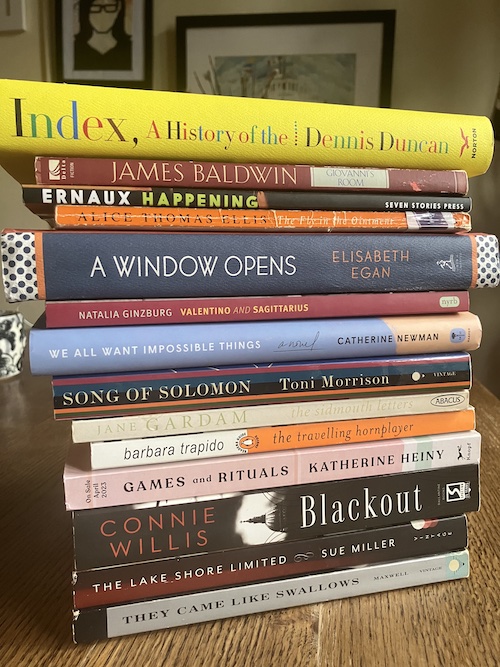
Our holiday break started a day before it was supposed to, as a blizzard raged outside and cancelled school and I curled up with THEY CAME LIKE SWALLOWS, by William Maxwell, a novel set against the Spanish Flu Pandemic and made me wonder why the word “unprecedented” was used at all in March 2020, because it really wasn’t.
And I read and I read, books I’ve been picking up here and there over the last year and finally time away from work (and social media) gave me time to delve into them. Some new books, others authors I love whose backlists I still get to delight my way through (Sue Miller! Toni Morrison! Natalia Ginzburg!). Barbara Trapido, whose work I’m falling in love with. I read HAPPENING, by Annie Ernaux, 2022 Nobel Prize Winner. OMG, SONG OF SOLOMON! GIOVANNI’S ROOM! Connie Willis’s time travel epic (and I have its conclusion still before me).
What a satisfying stack this is, a stack that’s inspired me to read (even) more off the beaten track in 2023, to pursue my own curious avenues.
Also now my “to be read” shelf is as spare and orderly as it will be for at least another year, and so before the deluge of new releases begins, I want to take a moment and appreciate that.






