March 31, 2017
The Everywhere Bear, by Julia Donaldson and Rebecca Cobb

My favourite Julia Donaldson is Julia Donaldson with Rebecca Cobb in The Paperdolls (even if I do have to add in that the little girl in the book grew up to become a particle physicist, a politician and an opera singer, as well as “a mother,” because let’s remind our children that a person can be very well rounded), so I was delighted to see their latest collaboration, The Everywhere Bear. Ticky and Tacky and Jackie the Backie don’t make an appearance, but we’ve got Ollie and Holly and Josie and Jay, Leo and Theo and April and May, etc. etc. All members of a classroom whose class bear comes along with the children on various adventures, but then one weekend things go amiss the bear gets lost, embarking on a remarkable journey of his home that will bring him home again. “Hooray! Hooray!” cheer my children at the end of books like these. “Nobody dies!” They will not tolerate an unhappy ending—even the paper dolls’ snipped up fate makes them a bit uneasy, but we all love this one, Donaldson’s bouncy rhyme and Cobb’s adorable round faces. A keeper for sure.
March 29, 2017
I love love love Workin’ Moms

Much like a certain recent US presidential candidate you may recall, the CBC television series Workin’ Moms is not a perfect candidate. There are some obligatory awkward Canadian production moments (Dan Ackroyd notwithstanding; his casting was brilliant); mild implausibility (how do the workin’ moms manage to fit a mommy’s group into their workdays?); and wardrobe decisions I didn’t blink at but that drove my actual workin’ mom friends berserk—apparently sleeves in the office are pretty much de riguere? Who knew. But over the first season of the show it’s become clear to me that perfection was never what the shows creators were striving for. They put a wandering kodiak bear in the pilot, for heaven’s sake. And it was that bear, or rather character Kate’s response to it, that had me hooked, her serious, furious primal scream. In that powerful moment we were witnessing a mother being born.
The show’s frequent comparisons to HBO’s Girls are not amiss in that neither is a series about women in general, which keeps tripping viewers up “because we’re still more comfortable seeing women as universal types rather than distinct individuals.” If women in general get this treatment, then mothers get it doubly, and the creators of Workin’ Moms are actively working against those expectations of who mothers are and what they should be. In fact, they’re working against all expectations, hence the kodiak bear.
From the start, here is what I loved about the series: first, that the characters aren’t foils. They’re people. That they aren’t having existential crises about matters most people really do manage to work out in reality if not on TV—like, “Oh my god, can I be a mom AND a person?” “Is it okay that I really like my job more than I like taking care of my baby?” “Is it simply inexcusable to admit that I find devoting my entire self to motherhood is more than a bit unfulfilling?” I mean, these are questions the characters in the show are working through, but it’s the process that matters—it’s not as though entire plot points hang upon them. I also like that the workin’ moms’ partners (who are dads, but for one exception) are generally decent human beings. Making dads look dumb is really stupid comedy, and this show is much too smart for that.
I knew I loved the show in the first episode when Frankie started fantasizing about being hit by a bus. She doesn’t want to die, she explains, but how she’d love to go into a coma for eight weeks or so. Later we see her with her head stuck under water in the house she’s showing for a sale. Soon after, she kinda sorta slips under water in the bathtub with her baby daughter—only just caught by her partner. She’s fallen asleep, she claims. A tiny slip. Enough to make the viewer very uncomfortable, which the series never fears to do.
Another character whose trajectory messed me up was Jenny, who headed back to her IT job reluctantly while her husband embraced his time as a stay-at-home dad, and thereby became completely unappealing to her, sexually and otherwise. She starts having weird fantasies about her nerdy manager, and leaving provocative messages on his Facebook page. Alienated from her roles as mother and wife, she starts acting out in outlandish ways, most memorably on the girls’ night out when she demands someone pierce her nipple, which squirts milk at the moment of laceration. Predictably, the nipple gets infected.
I loved Anne, who’s struggling with her older daughter (oh my gosh, when she starts wondering if there’s a slut gene and she’s passed it onto her) and a young baby when she realizes she’s pregnant again. This accidental pregnancy does not come as good news, and she struggles with facing it in her characteristically blunt style—”You’re angrier than usual, Anne,” the leader of the mommies group remarks to her. The group in general in general is a bit put off by the fact that Anne keeps bringing up that she’s considering an abortion. Which is kind of sacrilege in a room full of babies.
And then yes, the abortion. It’s long been a complaint of mine not just that abortions aren’t shown on TV very often, but particularly that nobody ever gets to make jokes about them. (I actually have a long term aspiration to become an abortion humorist.) Workin’ Moms going against the grain again as Anne’s friend Kate (who’s played by show creator Catherine Reitman) cracks this one as she’s driving Anne to a clinic and they’re considering whether you’d Yelp an abortion clinic based on ratings or proximity. Ratings, definitely, Kate figures, and then she takes it further: “I wonder what kinds of complaints an abortion clinic gets? One star. Still pregnant.”
And Kate, my favourite. All life in the city—she’s glorying in the beauty of the day in the park with her son as a vagrants’ pissing against a tree. Sardonic, bad-assed and unapologetic—particularly about her lack of sleeves. Her story throughout the series involves her return to work at a PR firm where she’s firmly established as successful, but she finds she has to redefine her professional role at work now that she’s a mother. Further, she’s a candidate for a prestigious position in Montreal, which would involve leaving her husband and son for three months. Is this something she’s willing to partake in for professional success? (Spoiler: in Tuesday’s episode we see her glorying in her clean white bed, alone, a full night’s sleep, and not a single soul to breastfeed. As any mother knows, there’s not drug in the world as incredible as solitude—but it’s also possible to get too much of a good thing.)
At the beginning of the show in January, Workin’ Moms received a terrible review from John Doyle in the Globe and Mail who chastised the show for its characters’ entitlement. “Oddly, to me, Workin’ Moms celebrates what was mocked with deft scorn by the Baroness Von Sketch series and the Canadian comedy Sunnyside. So, whose side are we supposed to be on? If it’s these appallingly smug people, heaven help us all.” But what the review only proves is that John Doyle doesn’t get it—it’s never been about sides. And what’s remarkable about Baroness Von Sketch and Workin’ Moms alike is that nobody is pitted against no one. Not unless, of course, there’s a very good reason…
In her celebration of Baroness Von Sketch, Kathryn Kuitenbrouwer writes of how the show “celebrates and spoofs the mundane realities in which modern, urban women find themselves depicted. And oh, how the Baronesses know the contours of the boxes in which we live. They have it mapped out like diligent and transgressive draughtswomen who, instead of yielding to the airtight edges of their inherited designs, work to erase them.” And I would argue that Workin’ Moms is a similar kind of project. More subtly though—this isn’t sketch comedy after all. And because it isn’t, the show has to develop in-depth female characters with sustained narratives, and some people hate that. Remember that flawed candidate I started this post with?
Workin’ Moms isn’t perfect, but it never wanted to be—which is the reason it manages to be transgressive, hilarious and discomforting all at once. And it doesn’t fucking care if you don’t like it, which is why I loved it.
The series finale airs next week, but you can watch the whole thing online.
March 29, 2017
Talking Canada Reads on the Radio

Today I got to talk about my favourite Canada Reads contenders from days of yore on CBC Ontario Morning. If you missed me on the radio, you can listen again on the podcast. I come in at 41.00.
March 28, 2017
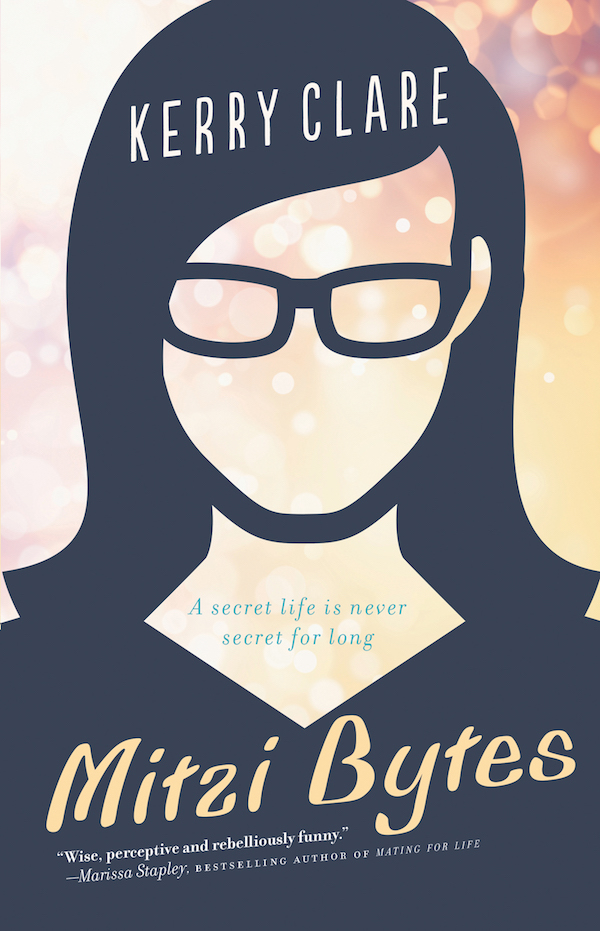
Mitzi Bytes in the World this Week

This week the “Mitzi Bytes in the world” distinction is literal. As per the photos below, Mitzi has been to Moscow, Paris, Jamaica, and Disney World. I have it on good authority that she makes for good poolside reading—and thank you to everybody who’s sharing their photos. The week’s big excitement was an appearance on Global TV’s morning show, which was as delightful as the clip makes it seem. I got to talk about blogging’s epistolary roots on television, and they asked questions about Harriet the Spy. It was amazing. This week, Mitzi Bytes was also the featured read on The Savvy Reader, which came with this serious endorsement. I love it. And I got to attend Blue Heron Books‘ Books and Brunch Series on Sunday, which apparently was the most raucous event they’ve ever had. So glad to be part of the raucous—we had so much fun.
This week, things are a bit quiet, but I’m looking forward to reading at the Pivot Reading Series on April 5 and then attending GritLit in Hamilton on April 8, where I will be participating in a panel with Merilyn Simonds on in the afternoon and teaching a blogging workshop at 5pm. It’s going to be great.

March 27, 2017
Barrelling Forward, by Eva Crocker
 I can’t help it, I need to read a short story collection like a novel. By “like a novel” I mean “like a book,” compelled to keep turning the pages. While I admire those who can dip in and out of a collection, read a story at a time, I’ve come to accept that in general, I’m never going to be that guy. If we’re speaking in terms of appetites and birds, when it comes to books I’m a raven. Which means I appreciate a short story collection like Eva Crocker’s debut, Barrelling Forward, whose momentum is suggested by its title.
The first story is “Dealing With Infestation” about a young teacher whose apartment is freezing and infested with something that’s left him itchy with a rash, when he embarks upon an ill-advised foray with his gym-teacher colleague. In “Auditioning,” a set of teenage twins are trying to get gigs acting in commercials, and one must resort to desperate measures to register her distaste with the whole exercise. In “Full-Body Experience,” an exercise instructor tries to get over the death of her sorta-boyfriend in a car accident. “Serving” is from the perspective of a father (middle-age man who works as a server in a family restaurant) and his teenage son, about the father’s innocent (?) relationship with a co-worker, and his colonoscopy. Work and family similarly intertwine in “All Set Up,” about a young father who waffles between contentment with his domestic situation and yearning for more. In “The Landlord,” a young waitress pushes the line about how far she’d go in order to avoid being evicted from her apartment. “Lucky Ones” is a tale of lottery tickets and Sherry, who’s taking care of her boyfriend’s baby while he works the night shift.
Eva Crocker’s stories of work and family life are reflective of modern realities, but underlined by more traditional notions of breadwinning and family structure, her characters are getting stuck in the gaps between these, sometimes perilously. All of these characters are gambling something, still hoping their ship will come in, which keeps the stories buoyant instead of bleak. And while not all the stories are equally successful, and this will be the kind of book that will frustrate you if you’re the type who disdains short stories for ending too soon, it’s a debut that positively sparkles with talent. Here’s hoping Crocker’s career achieves similar momentum as well.
March 24, 2017
Town is by the Sea, by Joanne Schwartz and Sydney Smith

Never has a book so literally sparkled like Town is by the Sea, a new collaboration by Joanne Schwartz and Sydney Smith. In the story, Schwartz draws on her own Cape Breton background to tell the story of a day in the life of a coal mining town, about the life that goes on up above while the men are working down below.

And in a book about contrasts, illustrator Smith pulls off a similar feat. As his early books (reissues of Sheree Fitch’s classics are where we first saw his work!) were fun and cartoonish, that same sensibility charges many of the images in this book—illustrations of domestic life and children at play. (He also exhibits a fixation on teacups that won this book a firm place in my heart.) But the teacups aren’t all of it—just wait for a moment.

Because first we see the men going down into the mines to work. (My children are fascinated by this. “What is coal?” Iris asks us, which is weird because usually she manages to parse out meanings, is rarely moved to ask about something so explicitly.)

“When I wake up, it goes like this—” Schwartz’s story starts, and this pattern sets up the way that the boy in the book will tell his story. First he hears seagulls, and then a dog barks. “And along the road, lupines and Queen Anne’s lace rustle in the wind…”

“And deep down under that sea, my father is digging for coal.”

And now here it is, that sea. A sea so sparkling that it appears animated, an image that would not look out of place in a museum. Hasn’t it got a bit of the Monet about it? Otherworldly. Which is fitting.
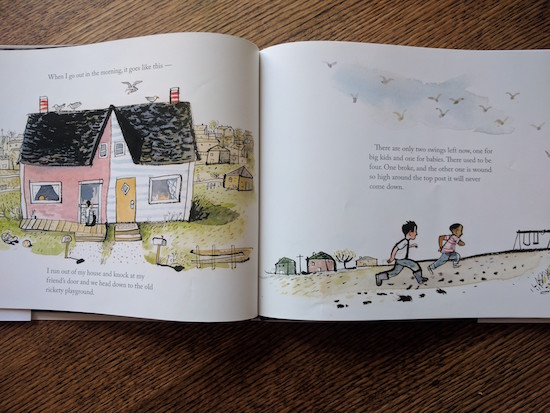
Meanwhile, the boy plays with his friends, he walks through town. He goes home for lunch, then goes back out again. The sea is perpetually present, and its evocation brings us back to the men in the mines. “And deep down under that sea, my father is digging for coal,” and my children read along with the refrain. But the last time we see the men, something is different.

The text doesn’t allude to the image of the men escaping some kind of collapse underground, and the sing-song story goes along, but what happens next in the illustrations takes on a particular subtext, a wordless story like the one Smith tells in JonArno Lawson’s award-winning Sidewalk Flowers*. The boy goes to visit his grandfather’s gravestone, his grandfather who was a miner just like his father, and who made sure that he’d be buried facing the sea because he’d spent enough time underground. “I go to the graveyard to visit my grandfather, my father’s father. He was a miner too. The air smells like salt. I can taste it on my tongue.”

The trouble underground and the imagery of death will make for some uneasy for reading for those of us who know the dangers of coal mining, who’ve heard the stories of disasters. But alas, that is a story for another day. In this book, the boy’s father comes home. Danger and peril, and it’s still just an ordinary day.

“One day it will be my turn,” the boy tells us, about the men who go down below to mine for coal. “I’m a miner’s son. In my town, that’s the way it goes.”

*Full credit goes to my husband Stuart who is much better at reading picture books than I am. It took me ages to figure out that the bear had eaten the rabbit in I Want My Hat Back, or what was different at the end of Sam and Dave Dig a Hole. I might have read this book a hundred more times without realize the enormity of what’s really going on beneath the surface (see what I did there?) so I am glad that I keep someone very clever around.
March 23, 2017
The Mother of All Questions, by Rebecca Solnit
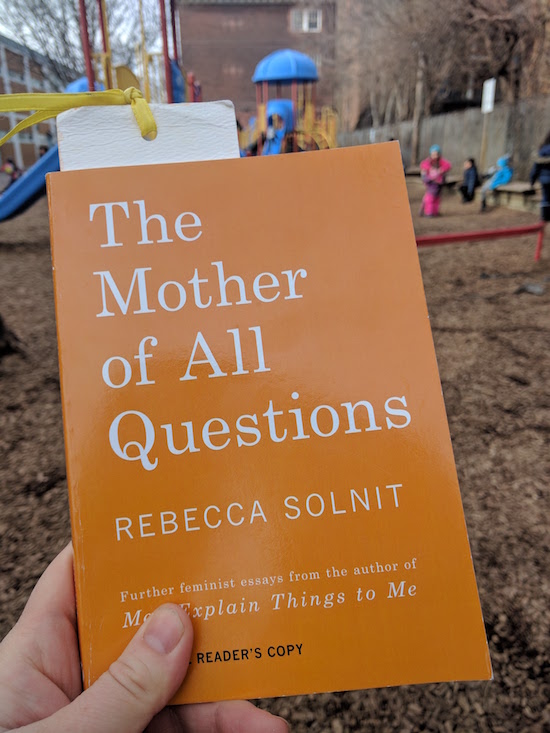
“There is no good answer to how to be a woman; the art may instead lie in how we refuse the question.” —Rebecca Solnit, The Mother of All Questions
Do you remember where you were when you discovered Rebecca Solnit? I do—I was listening to The Sunday Edition on CBC and she was talking about her book, The Faraway Nearby, a book that had a line of prose running throughout the bottom of every page. I read The Faraway Nearby, and fell in love with it, writing this effusive response. This was in 2013. In 2013, we still didn’t know that the world would fall apart and that I’d come to rely on Rebecca Solnit so much to put the pieces back together.
Solnit started particularly steeping in the zeitgeist with her 2012 essay “Men Explain Things to Me,” which lead to the term “mansplaining” although she’s far too elegant a writer to have invented it. The essay was part of a collection of the same name on feminism that was published in 2014, which was the same year that many of the essays in her latest, The Mother of All Questions, were written. “I’ve been waiting all my life forget what 2014 has brought,” her essay, “An Insurrectionary Year” begins, about that “watershed year” in which conversations about rape and sexual violence started changing. It seems like a long time ago now.
There is a Rebecca Solnit book for every moment—and sometimes for two of them. Her collection of essays Hope in the Dark was first published 2004 in light of George Bush’s re-election and the American invasion in Iraq in spite of global demonstrations for peace the likes of which had never been seen before. After the 2016 US election, the book was reprinted and I read it with such gratitude—it gave me comfort. I was reading it as we marched on January 21, and it made me feel buoyant for the first time in months. It indeed brought me hope, and perspective. There have been hard times before, activism is always a process, it’s always too soon to go home, and that you never know what effects your actions will achieve. There are grounds for hope. It’s a reason to bother.
The Mother of All Questions is another book about feminism, although it reads less triumphantly than such a book might have a short time ago. Before the patriarchy saw fit to elect an incompetent sexual predator to its highest office, because the alternative was a smart and qualified woman who rubbed a lot of people the wrong way. They sure showed her though, and all of us, where we’re at in terms of gender politics and equality. It is true that with the elections all my illusions about feminism and progress went kaput, and I’ve been functioning in a state of perpetual heartbreak ever since then. To think I’ve been raising my daughters to have a voice and to take for granted that their ideas and input would be valued by the world—what was I even thinking?
The ideas Solnit takes on here involve silences: “Being unable to tell your story is a living death and sometimes a literal one.” She writes about the people who weren’t permitted to speak, and the tales that weren’t allowed to be told. She writes about the men who are silenced by patriarchal forces, from being themselves, telling their own stories. She writes about rape, consent, domestic violence. She writes about the silence that occurs because no one is listening. About new and difficult conversations that have started to happen in the last twenty years or so, attempts to reconcile the unreconcilable (and the backlash). Most of these essays have appeared elsewhere and I’ve read a few of them, but it does me good to read them here assembled all together. There are many ways that I process the world, but reading Rebecca Solnit is a very important one of them. It’s true, I don’t read for her interrogation. I read her for comfort. Wanting comfort is not such a terrible thing.
However. “All your faves are problematic,” somebody tweeted last week, possibly in response to Chimamanda Ngozi Adichie’s comments about transwomen. And it’s true, and Adichie’s comments were ignorant and she’s not the spokesperson for every single living thing, but I’m not sure there is anybody who isn’t problematic. Remember the year we had to keep quiet about our admiration for presidential candidate Hillary Clinton because she too had failed to be perfect? And I went along with that. It was a silence. To admit one’s lack of socialist principles, and her Iraq war vote. She was the establishment, and there was Wall Street. She wasn’t even cool. Similarly, I had go to keep my excitement about Caitlin Moran’s new book on the downlow because she was racist and ignorant in a tweet in 2011. Which was problematic. But everybody is problematic. (It also seems that there is nothing more problematic than a woman being popular. Or in particular being popular with other woman. If too many women like you, then you’ve suddenly lost all your cred.)
I think we need to give women the space to be problematic though. I think we have let our feminist heroes cause trouble, and be wrong, and not even to atone if they don’t want to. We need to let people complicate things. We need to let others rail against it. That’s how progress happens. That’s how truth emerges. Uncertainty is okay, containers are porous. And I keep returning to the quote I started this essay with, “There is no good answer to how to be a woman; the art may instead lie in how we refuse the question.” Rebecca Solnit keeps refusing it admirably.
March 20, 2017
Mitzi Bytes in the World this Week

The neat thing about Mitzi Bytes in the world this week is that Mitzi Bytes is actually in the world this week! The book launched on Tuesday, whose highlights were the appearance of an excellent review in Quill and Quire (“The novel’s cover makes it seem like a light read–and it is fun… At the same time, though, Clare makes us rethink what it means to be a mother, daughter, husband, and friend, and places the book directly within the current conversation about parenting in the 21st century.”) and an appearance on CBC Here and Now. I am also particularly proud of this review by Rohan Maitzen, who is a critic I admire immensely. On Thursday, we had our launch party here in Toronto, which was sponsored by the Toronto Lit Up Program via IFOA and the Toronto Arts Council. It was a terrific evening, and I got to read the ventriloquist sex scene, so that was amazing. It was so nice to have so many friends there and celebrate properly, and sign many many books. So grateful to Ben McNally Books for hosting us!

On Saturday Mitzi Bytes received the best imaginable review possible in the Toronto Star, which concluded with “Entertaining, engaging and timely, Mitzi Bytes is a pleasure to read from start to finish. It heralds the arrival of a fantastic, fun new novelist on the Canadian scene.” So THAT was nice. (!!!!) And then we were off to Peterborough for a hometown launch at Hunter Street Books, and we sold all the books. Which I can’t take much credit for, really. It just turns out that I am the child of incredible networkers (and very proud parents!) who invited everyone they’d even known to the launch and are well-liked enough that the people even came. I am so grateful to everyone who was there, and glad we had very cool Mitzi Bytes cookies for everybody. It was a really fun event, and great to see old friends and hang out in Michelle Berry’s wonderful shop. It was a grey and gloomy day, but the inside bookstore was so bright.
PS It was nice to read reviews from the HCCFirstLook program. I am grateful to these great readers for talking about the book.
March 19, 2017
So Much Love, by Rebecca Rosenblum
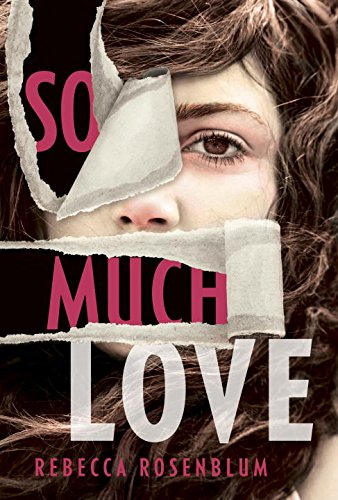 My friend Rebecca Rosenblum’s third book and debut novel So Much Love launched on the same day my book did last week, although I’d picked up a copy (from Indigo’s “New and Hot Fiction” table) two days before. I’d read it years ago in manuscript form and really liked it, and it was to my great joy to discover as I read the book last week that everything I remember loving about the first version—lines and scenes and settings—were still there, but that all the pieces of the story had been pulled together into a beautiful package that reads as seamless. It’s an incredible book, about the disappearance of a young woman and the devastation her absence leaves, and we also hear from the woman as well, and from a poet who’d been murdered in an act of domestic violence years before in a story with strange parallels to the central story. But not so many parallels—maybe vague connections are a better descriptor. Because to say there were parallels suggests that two characters’ stories might be alike, or that the the people who populate the novel are anything like types, because they’re not. And that’s so remarkable. The specificity with which the novel’s characters are evoked, every single one of them. I am awed by how Rebecca manages to imagine a 50-year-old male college professor reflecting on decades of marriage, a single mother desperate at her grown daughter’s absence, a kidnapper, a waitress, a poet, a builder. Each of them so stunningly realized—it’s magic. Sometimes the characters are so singular that it makes me wonder why—Catherine Reindeer, mature student, married young, works as a waitress, taking just one class a semester because she’s determined to avoid student debt. Which comes full circle, because, why? Because that’s who she is. These people are alive, and their city has its specific geography, and they all have their histories, and not all of it is delineated, but it’s there. We know it’s there. The whole novel was so enveloping, which is what hooked me, even though this is not a novel you’d call “deftly plotted” or “chockfull of suspense.” Which is not to say it’s boring or slow, but it more cerebral. It’s a novel whose atmosphere the reader steeps in rather than races through, and I loved that. Even though it wasn’t always easy—Rebecca avoids sensationalizing violence and only alludes to the worst bits, but it’s all very emotional wrought. There is so much sadness…and yet. And the title then, the so much love. Which is, of course, the whole point.
I loved this book. It’s an incredible achievement. I’m so proud of my friend.
March 17, 2017
You Are Three, by Sara O’Leary and Karen Klassen

Three is a good age, is a thing that someone said to me today, and it might have been the first time I ever heard that. I cocked my head. “Oh, really?” Although she was talking about her grandchild and maybe three is a good age if the child is only yours on a partial basis. For the rest of us though, three is a battle. Three is ferocious, still wakes you up at night and no longer naps. Three has more complex needs, and will still bite you in a pinch. Three is strong and tenacious and refuses to give in, and can whine and whine until the sun goes down. And keep on whining.

And yet. Three is also sturdy legs that can walk long distances with no complaints. Yes, three will point to your stomach and remind you that you look like you’re having a baby, but three will also whisper in your ear that you look like a princess. You never even knew you desired to look like a princess, but you are satisfied. Three tells stories about her friends at school, and eats everything in her lunchbox even though she never eats at home. She loves cats, but only if they are pink. Three likes to read chapter books because her big sister reads chapter books, and she picks sparkly ones out at the library with fairies on the cover, and she sits alone thumbing the pictureless pages and you wonder what she sees.

So yes, three has been a good year, even though three is hard and stubborn and still screams when you are unable to conjure impossible things. Three will howl for blocks and blocks or run away from you in a crowded subway station just to demonstrate how much she doesn’t want to hold your hand. But three will also sit at the table, most of the time. She will tell jokes and contribute to discussions and ask questions and point out things you never would have noticed on your own. With a three-year-old, you are a family, instead of three people and a baby. Your seven-year-old will say to you, “It’s really great to have a sister you can talk to.” And you will only be partially totally confused about what exactly she means.

(My favourite thing in the world is listening to my three-year-old singing along to songs that my seven-year-old is making up on the spot.)

Three is a good age, because it means we no longer have a baby. We never wanted another another baby after we had our last one, and I don’t lament the end of the baby years. My baby is heading off to kindergarten in the fall and I am fine with that. This is why we had babies anyway; the babies were what we had to go through to get the kids. And we love the kids. We toss the baby stuff out to the curb and cheer, and have filled all that space with camping equipment.

And so I was surprised to be moved by You Are Three, the final book in Sara O’Leary and Karen Klaassen’s trilogy celebrating the milestones of toddlerhood. Flipping through the pages the other night, I felt a bit emotional. Because three is a cusp, about to unfurl. Three is a person’s threshold to the world, and while I’m ready to usher my little person through the door, it’s easy to forget the moment we’re in. This funny girl will never again be so funny, or at least not funny in the same way. The You Are Three book reminds us to notice where we are right now: the kid who rides a scooter, carries her umbrella, and loves to hide. Her incredible worlds of make-believe, and her pictures, and the ways she sings her ABCs. “You are still our baby/ but you are also your own person./ We love to hold you close/ and we love to watch you run.”