August 30, 2012
Olivia and the Fairy Princess
 Oh, I had my concerns once I’d realized that the new Olivia book was called Olivia and the Fairy Princesses, but I should have had more faith in the brilliance of Ian Falconer. The new Olivia is pure princess-fighting propaganda under the guise of as a very good book. Olivia, the book tells us, is having an identity crisis. She doesn’t understand why all the girls (and even some of the boys!) are so desparate to be princesses. They want to be princess ballerinas at dance class, all the while Olivia is going for something stark and modern. They all dressed up as princesses for Halloween, while Olivia dressed up as a warthog. (“It was very effective.”) Why do all the girls want to be the same thing, Olivia wonders? If everybody is a princess, then how can princessing be special?
The very best thing about this book is that its packaged up in princess pink, and so will no doubt find its way into the very grubby (rhinestone-studded) mitts it’s intended for, as well as into the baseball mitts of the daughters of those of us who’ve been reading Peggy Orenstein, provoking some discussions and inspiring some critical thinking too. The book will also have its detractors who resist a story with such obvious politics whose Eloise-ish narrative is a wink-wink at the grown-ups, and it definitely is possible that I love this book way more than Harriet does.
Than Harriet does so far though. I’ll work on this. So glad to have another weapon (and such a smart one too!) in my princess-fighting arsenal.
August 29, 2012
No one liked knocking on an open door
 “A dear little wooden gate opened on to the rising path and above it the front door stood wide open. ‘Coee,’ she called, wondering briefly what others said when they arrived at an open door and thus were deprived of the opportunity to knock. Italians, Zulus, Serbs, Welshmen. What did they say? No one liked knocking on an open door. It was unnatural.” –Alice Thomas Ellis, The Fairy Tale
August 28, 2012
Swimming Studies by Leanne Shapton
 It occurs to me that I could write a swimming memoir too. I was never, ever a competitive swimmer, but my life has been punctuated by pools, shores and bathing suits. There was the pool in Bangkok in 2004, with my husband, who was my boyfriend, when we were marooned in the city after missing a flight and we went swimming together for the first time in our two years together and discovered a whole new level on which we connected, that we both adored the water. There were the turquoise rectangles and kidneys that dotted the backyards of my childhood suburban landscape, the yards you’d calculate to be invited into on the very hottest days.
I learned to swim at Iroquois Park in Whitby Ontario, and then at the Allan Marshall Pool at Trent University after my family moved to Peterborough. I met my best friend at the Trent pool, at swimming lessons when we were both 13, and seven years later we’d be swimming together at a reservoir when someone pulled a body out of the water.
There were hotel and motel pools with my sister when our family was on vacations. Our backyard pool during my teenage years. The Hart House Pool at UofT, which I swam every day when I was pregnant (which was the same time at which I’d become obsessed with reading books about swimming). And also the Turkish bath in Budapest, where I once went swimming a long time ago when I was pregnant but did not want to be.
And this is the impact that Leanne Shapton’s beautiful books always have on me, her own experiences or her imagined ones leaving me awash in my own thoughts, memories and questions– see my posts on Native Trees of Canada and Important Artifacts. For me, her books point away from themselves, even in their remarkableness and their beauty as objects. (Shapton is a book designer, as well as an author and illustrator.) Which is not to say that her latest, Swimming Studies, is not an incredible book, one of the best I’ve read this year. In her curious collection of sketches-cum-memoir, Shapton teases out the connections between her past as an Olympic swimmer and her present day experiences as an artist in New York City. How did she get from there to here? How do her two selves inform each other? Are they really so separate after all? How does the discipline required for athleticism inform an artist’s life?
Swimming Studies is an exercise in nostalgia, a love letter to places where we no longer belong. I was never, ever a competitive swimmer, but I remember the kids in my class who always smelled like chlorine, which made their skin flake and their hair turn green. I remember their t-shirts that said, “No Pain No Spain.” I remember Victor Davis and Alex Baumann, and in 1984 I was in the crowd at an Anne Ottenbrite Parade, celebrating her gold medal, the very first parade I’d ever seen that didn’t end with reindeer. I found it all fascinating and strange.
But I remember too having strong feelings about the logos on my sweatshirts. Shapton writes, “When I follow a trend (plastic bracelets, neon lycra), I get nervous. Mosquitos and wasps are attracted to my fluorescent-yellow sweatshirt. I spent an unhappy year in seventh grade trying to look preppy with the wrong ingredients…” She writes of her older brother, “I was always watching Derek for signs of what was possible, how to make decisions, what to like and how to tell. I knew he wanted to lose me, and I tried to keep my distance, but I wore the same Converse All Stars as he did, the same jeans…” One chapter begins, “My first visit to Ottawa was with my sixth-grade class…” I know these reference points, Phil Collins playing on the car radio. Watching through windows for your mom’s headlights, for her car to pull into the lot to take you home.
Swimming Studies is a difficult book to explain, and I’m glad that I get to review it in my blog so that I don’t necessarily have to. That I can simply say that the whole thing just works, for no reason I can really fathom. Leanne Shapton writes about ponds and pools she has known– the Hampstead Heath Ladies Pond, the pool at the Chateau Laurier, the baths in Bath, and so many others. She writes about morning practice: “Ever present is the smell of chlorine, and the drifting of snow in the dark.” A many-page spread displays her extensive bathing suit collection. She includes drawings of her teenage swim teammates, with brief biographies for each: “I’m not crazy about Stacy since noticing that she copied onto her own shoes the piano keys I drew on the inside of my sneakers.” About quitting swimming twice, and how the swimmer inside her cannot be shaken, and how she’s had to learn to live with her. Paintings of pools, of figures in the water. A chapter on her obsession with Jaws, with Jaws as metaphor. Her fascination with athletics, with athletes who aren’t champions: “Their swims, games, marches aren’t redemptive. Their trajectories don’t set up victory.”
It works, and maybe you have to understand the lost world that she’s conjuring in order to really get it, or maybe you just have to understand the nature of lost worlds at all.
**
 I bought my copy of Swimming Studies on Saturday on the way home from a splendid afternoon at the Christie Pits pool, the pool that this wonderful hot summer has given us many occasions to appreciate. Our visit was particularly notable because the water slide was on, and also because it was the debut of my brand new bathing suit which I’ve been waiting all summer for. It’s my mail-order bathing suit, an idea that was always going to turn into a saga. It’s the Esther Williams Class Sheath, which I purchased after seeing it endorsed by trusted bloggers at Making It Lovely and Girl’s Gone Child. It arrived too late for our vacation, but actually fit (albeit snugly, requiring me to do a funny little dance in order to get into it). And it’s lovely, so I was happy to have an opportunity to wear it when summer came back to us this weekend. We didn’t bring our camera when we went to Christie Pits, so I decided to wear my suit again the next day at the wading pool, just so you can see how excellent it is. No ordinary bathing suit would drive me to post a photo of me wearing it on the internet, let me tell you. So maybe this is the beginning of a new internet meme called Book Bloggers in Bathing Suits? Like all proper book bloggers, however, with our sensitive skin and lack of propensity for pin-up-ness, I’ve had to delay this big reveal for a week or two because I was waiting for a rash to go away.
August 27, 2012
M is for Market

Location: Casa Acoreana Cafe, Baldwin St & Augusta Ave, Kensington Market
August 26, 2012
Suspicion by Rachel Wyatt
 Of course, there’s been that one book that everyone’s been talking about this summer, but in more discerning circles, that one book has been Gillian Flynn’s Gone Girl. I was sold on it by buzzing from reliable sources, as well as back cover blurbs by Kate Atkinson, Laura Lippman and Kate Christensen, which is some kind of pedigree. I devoured Gone Girl the first day of my vacation last month, and adored how Flynn sent-up and played with tropes of the mystery and thriller genres in her smart, funny, and very contemporary novel. It was a “whodunnit” in which we (thought we) knew “who”, but the “it” remained the question, compelling us through a whirligig of twists and turns.
In her new novel Suspicion, Rachel Wyatt has given us a Canadian version of Gillian Flynn’s summer sensation. Similarly, a woman has gone missing, and suspicion falls upon her husband. The backdrop to the story is a troubled economy that might drive anyone’s desparation, and it turns out that few people in the supposedly close-knit community of Ghills Lake know their neighbours quite as well as they should. And that those who do know a little too much…
The twist in Suspicion, however, is that the “it” in “whodunnit” is precisely nothing, and the “who” is no one. Candace Wilson is missing, not because her husband did her in to get sympathy for his unpopular development project that threatens to mar the waterfront in their BC interior community, and not because her ex-lover’s wife killed her out of spite (and besides, how could she from her wheelchair?) and not because her resentful sister had finally had enough. No, as Wyatt makes clear from the start, Candace has stumbled into a deep hole hidden in the ground (not metaphorical) and she has broken her leg. She is trapped in the hole with no hope of rescue, what with everyone being all-consumed by far more dramatic theories involving murder, kidnapping, and scandalous trysts.
As with Flynn’s book, the characters in Suspicion find themselves unwitting players in a plot well-recognized from books, movies and TV. Against all their instincts and best intentions, they find themselves playing to type, the suspicious husband looking even more suspicious after he gets arrested for driving drunk, acts strange in police interviews and sleeps with his sister-in-law. The sister-in-law too is pulled between her own suspicions, her feelings for her sister’s husband, and her shameful feelings of relief about her sister being gone.
Other characters begin to manipulate the story for their own purposes, the wheelchair-bound wife of Candace’s ex-lover sharing her own theories on the internet forum where she commands authority, Candace’s sister’s husband finding himself overwhelmed by visions of Candace’s whereabouts which he employs in his mediocre art, and a journalist who’s turned up in town searching for some local colour is spinning her own impossible version of events. The police chase up one hopeless lead after another, all the while Candace is lying underground, cold and hungry and losing consciousness.
Suspicion is a literary trick masquerading as a great suspense novel, a story with meta-elements in which characters must reconcile the fact that they’ve become characters. Some resist, others revel, and we are shown how story, plot and drama are born in ordinary places, in ordinary lives. The only problem with this approach, of course, is that Wyatt’s characters acting as stock-characters can begin to seem a little too much like stock-characters, at times more to due sloppy plotting than a literary sleight-of-hand. There are a few too many scenes with hysterical women fleeing rooms in tears, with men struggling to contain inexpressible rage, smarmy types too eager to capitalize on Candace’s misfortune. There is a fine line between those characters who think they’re people on a page, and the people on a page after all. Even if they’re actually people on a page (and here is where my argument begins to look like the girl on the Borax box who’s holding a Borax box on into infinity).
But for the most part, Wyatt has drawn this line well, and ultimately, Suspicion is successful. Like Gone Girl, it’s a book very much of its time and place, very evocotively “there and now”. And while readers will come for the promises of gripping suspense, they’ll stay for the literary play, and the novel’s reflections on modern life, and love and marriage.

August 22, 2012
The Vicious Circle forgives us our trespasses
 Last Thursday, our book club hit what was either an all time low or an all time high, depending on your point of view. If you think it was the former, we will assure you that it wasn’t our fault, but that we’d elected to barely discuss the book at all (a rare act of defiance for the Vicious Circle, which is constitutionally obliged to discuss the book in question at least half as much as it discusses Russell Smith at every meeting) simply because the book was unremarkable. Not in the same way that Wayne Johnston’s Human Amusement was unremarkable, so bizarrely unremarkable that it blew one’s mind with its sheer uninterestingness; how could any book be so thoroughly boring (though to be fair, she of us who writes the blog post recaps felt this most among us, hence the lack of a blog post recap)?
No, instead the book (which was Trespass by Rose Tremain, her follow-up to the Orange Prize-winning The Road Home [which is a book, it has been reported, that gives Orange Prizes a bad name]) was mind-dumbingly uninteresting. We’ve had a conversation many times inside the Vicious Circle in which one of us makes disparaging remarks about the awfulness of genre-fiction–that it’s not the genre, but the awfulness that troubles. And another of us always points out that literary fiction also has its fair share of crappy books, books that exist solely to meet the lit-fic formula, to win orange prizes, and which actually have no souls of their own. And here was one.
Trespass was stupid, those of us who’d finished shrugged and said it was all right, but that her characters weren’t really people, that elements of the text were preposterous, that we couldn’t understand how it had received that terrific review in The Observer. And then, really, there was nothing more to say, so we moved on to ol’ Russell, debating Caitlin Moran and saying goodbye to one of our own who is decamping to Mexico in the coming days! Though we were saying goodbye via cake, which helped. And it was weird, because we’ve been a book club for almost 2.5 years and the time has flown by, and we’ve had the perfect dynamic, diversity, connection between our members. So we are very sad to see one of us (and she assures us that it wasn’t Human Amusements and Trespass that drove her to it).
We also decided that we had had enough of mediocre books and that maybe we’d all been a little too enthusiastic and uncritical when we planned our next two years of reading about a year ago. So we threw out the list and started anew. No more middling CanLit, no more books chosen because they’d been sitting on our shelves for years and a book club pick would make us pick it up finally. We decided to be more deliberate in our choices, to pick books that are either mostly likely good or that will foster good conversation.
So that we don’t have any more book-free conversations at our meetings in the future. Not that we mind so much when we do. Because even with Trespass and also without it, ours was a very splendid evenings.
August 20, 2012
The Book of Marvels by Lorna Crozier
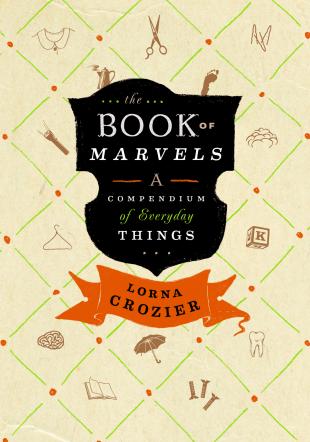 The most disappointing book I ever received was a book of household tips containing such wisdom as how to clean decanters and select bathroom soaps, and poet Lorna Crozier’s new book The Book of Marvels: A Compendium of Everday Things is that disappointing book’s most polar opposite. Fitting for a book that renders ordinary objects extraordinary, Crozier’s book itself is an extraordinary object, one of the few books I’ve ever encountered that dazzles you when its dust jacket falls off: the book is argyle. Its design is splendid, and the contents will not disappoint, guaranteed to appeal to anyone who loves words, and stories, and the thingy-ness of things.
Arranged in alphabetical order, The Book of Marvels is a dictionary of sorts, each definition illuminating the extraordinary lives of objects that we rarely look at twice. Sometimes Crozier will regard a familiar object from an unusual point of view (“Bed: Solid. Immovable. It does little more than take up space in the room it gives its name to, but at night the bed could be any kind of boat…”), use it to tell a story (“The shoe the old dog dropped on the step at dusk… It’s a man’s shoe, black, with a built up sole, as if the owner is a 1950s’ child of polio. Perhaps he’s not lame, just short, and the partner of this show is also heightened…”), invent mythologies (“The first rake was a hand. The older the better, rachitic fingers permanently bent, a scraping tool of bone and flesh…”),or uncover the hidden life within (“All doorknobs are twins, joined at the centre by a bolt narrow as a pencil, inflexible, unvertabraed. Though they move as one, they never get to see each other. They are like siblings separated at birth by a war, by a wall of stone and razor wire”).
I can tell you that I delighted in reading this book on the bus last week, in being the woman seen reading an argyle book called The Book of Marvels, in nearly falling down every time the bus lurched because I’d let go of the hanging strap in order to frantically underline all the best bits. Sometimes the underlines were because the idea was so right, so perfect: “Flashlight: It feels neglected. Too often it’s merely a case for carrying dead batteries.”Or: “The mop lacks the mystery of the broom. No one thinks of it steering through the stars.”
Or the writing: “Shovel:… You’d swear it is a noun but it’s a verb, in stasis, waiting in the shed for a shift of circumstance or season.” And there is this: “Snail: It sails without sails in the garden, so slow, if it were a ship, there’d be no wind.”
The one I went around reading to everybody on Friday was from Fork: “It’s the only kitchen noun, turned adjective, attached to lightning.”
And oh, how I loved: “Whatever it’s called, its country of origin, in a past life the umbrella must have harmed the wind–the wind, without doubt, plots its undoing.”
The Book of Marvels was the title of Marco Polo’s travel writings, and also those of traveller/adventurer Richard Halliburton, and is a title that would set up high expectations for any book, even without the allusions. Lorna Crozier not only meets these expectations, however, she exceeds them, in her excellent argyle book which affirms with delectable language that the world’s wonders are all around us.
August 19, 2012
How to keep more books
 I had a revelation yesterday afternoon: if we had a taller bookshelf, we could keep more books. And as we’ve completely run out of floor/wall space for book storage, this revelation was truly a revolution. I did a search for tall bookshelves on Craigslist and very nearly forgot my recent vow to buy no more furniture that isn’t really furniture (bookshelves with cardboard backs or made of particle board), and then I found a listing for a solid wood bookshelf for only $40. The ad had been up for a week, but I got an immediate response from a seller who’d only just started answering her responses and who’d recognized my name as we had a mutual friend. She also just lived up the street, which was handy, so I took a trip there last night in the Autoshare cargo van, and brought this beauty of a bookshelf home. Of course, its arrival has instigated a massive clear-out/re-organzation that has since turned the entire house to chaos, and resulted in a massive pile of free books being put out on the curb (which were gone in two hours, and yes, my bookish garden is better for the pruning). The task before me now is to clear out our garret-turned-overstuffed-storage-closet, which is totally terrifying. But in the meantime, there is the brand new bookshelf, and we’re absolutely in love with it.
August 16, 2012
Mary Poppins and Afternoon Tea
 “So, still admiring themselves and each other, they moved on together through the little wood, till presently they came upon a little open space filled with sunlight. And there on a green table was Afternoon-Tea!
A pile of raspberry-jam-cakes as high as Mary Poppins’s waist stood in the centre, and beside it tea was boiling in a big brass urn. Best of all, there were two plates of whelks and two pins to pick them out with.
“Strike me pink!” said Mary Poppins. That was what she always said when she was pleased.
“Golly!” said the Match-Man. And that was his particular phrase.
“Won’t you sit down, Moddom?” enquired a voice, and they turned to find a tall man in a black coat coming out of the wood with a table-napkin over his arm.
Mary Poppins, thoroughly surprised, sat down with a plop upon one of the little green chairs that stood round the table. The Match-Man, staring, collapsed on to another.
“I’m the Waiter, you know!” explained the man in the black coat.
“Oh! But I didn’t see you in the picture,” said Mary Poppins.
“Ah, I was behind the tree,” explained the Waiter.
“Won’t you sit down?” said Mary Poppins, politely.
“Waiters never sit down, Moddom,” said the man, but he seemed pleased at being asked.
“Your whelks, Mister!” he said, pushing a plate of them over to the Match-Man. “And your Pin!” He dusted the pin on his napkin and handed it to the Match-Man.
They began upon the afternoon-tea, and the Waiter stood beside them to see they had everything they needed.
“We’re having them after all,” said Mary Poppins in a loud whisper, as she began on the heap of raspberry-jam-cakes.
“Golly!” agreed the Match-Man, helping himself to two of the largest.
“Tea?” said the Waiter, filling a large cup for each of them from the urn.
They drank it and had two cups more each, and then, for luck, they finished the pile of raspberry-jam-cakes. After that they got up and brushed the crumbs off.
“There is Nothing to Pay,” said the Waiter, before they had time to ask for the bill. “It is a Pleasure. You will find the Merry-go-Round just over there!” And he waved his hand to a little gap in the trees, where Mary Poppins and the Match-Man could see several wooden horses whirling round on a stand.
“That’s funny,” said she. “I don’t remember seeing that in the picture, either.”
“Ah,” said the Match-Man, who hadn’t remembered it himself, “it was in the Background, you see!”
The Merry-go-Round was just slowing down as they approached it. They leapt upon it, Mary Poppins on a black horse and the Match-Man on a grey. And when the music started again and they began to move, they rode all the way to Yarmouth and back, because that was the place they both wanted most to see.
When they returned it was nearly dark and the Waiter was watching for them.
“I’m very sorry, Moddom and Mister,” he said politely, “but we close at Seven. Rules, you know. May I show you the Way Out?”
They nodded as he flourished his table-napkin and walked on in front of them through the wood.
“It’s a wonderful picture you’ve drawn this time, Bert,” said Mary Poppins, putting her hand through the Match-Man’s arm and drawing her cloak about her.
“Well, I did my best, Mary,” said the Match-Man modestly. But you could see he was really very pleased with himself indeed.
Just then the Waiter stopped in front of them, beside a large white doorway that looked as though it were made of thick chalk lines.
“Here you are!” he said. “This is the Way Out.”
“Good-bye, and thank you,” said Mary Poppins, shaking his hand.
“Moddom, good-bye!” said the Waiter, bowing so low that his head knocked against his knees.
He nodded to the Match-Man, who cocked his head on one side and closed one eye at the Waiter, which was his way of bidding him farewell. Then Mary Poppins stepped through the white doorway and the Match-Man followed her.”
-From P.L. Travers’ Mary Poppins, which our whole family has been so enjoying for the past week or so.






