March 14, 2011
Ephemeral, yet eternal
My husband told a story at dinner the other day that involved a coyote and a mountain lion. “Like in Fauna,” I said, and we talked about the characters in this book we both read months ago, then we marvelled at how much the book had stayed with both of us. It’s not every book that does that, taking over dinner conversation as you put the pieces of the plot back together in your memory, and I continue to believe that Fauna is a really exceptional novel. That it is exceptional and never won any big book prizes, however, is to my mind no contradiction.
Fauna was exceptional for many reasons as a book, but not as much as an example of the novel form, and I think this is the reason it did not win any prizes. That it didn’t win prizes is not to say that it’s not a worthy book, but that a worthy book didn’t win a prize is also not to say it was robbed. Prizes are not the sole determinate of worthiness. And I’ve been thinking of this lately, considering the number of books I read that are considered unrecognized because they’re not short or longlisted by Giller and the like. The notion of the “snub”, the entitlement behind that notion, as though everyone deserves to be a winner. As though prizes were handed out on an assembly line, when really sometimes it’s the books that seem to be produced that way, so can you really be surprised when yours isn’t a winner?
But what I really mean to say is that there is a place for these books, all those books I read last year, for instance, that will never win a prize and should never win a prize, but that I thoroughly enjoyed reading anyway. That to be read is to be recognized, and I know it doesn’t come with much of a paycheque, but it’s everything, even without a gala. The ordinary couple discussing your story over macaroni is what you’re writing for, and the shelves upon which your book will forever dwell, and the dust that will gather on its pages over time to be blown away the odd time the book is opened– this is what you’re signing up for. The way the story will live on in readers’ minds, the connections they’ll draw between your story and others, and world outside the bookshelves, even. Something oddly ephemeral, yet eternal, less quantifiable than a grand prize win, but it matters, and it means your book matters, even if you didn’t win.
March 13, 2011
Canada Reads Independently 5: Play the Monster Blind by Lynn Coady
 There were two stories in Lynn Coady’s Play the Monster Blind that ended so unsatisfyingly that I was able to perfectly understand the sentiment of those people who say they don’t like reading short stories. I like stories that are a kernel of a bigger idea, stories which (however ambiguously) contain all the answers to any questions about what happened before or what’s going to happen next, but one of these ended with a boy about to descend down a slope whose precariousness may or may not kill him. I mean, it’s a testament to the story that I cared so much either way, but still, I thought, come on now
But it is a testament to this book’s all-round wonderfulness that it was these two stories that were linked to stories that came later in the collection, stories that answered my questions about precarious slopes, and invested their characters with whole other dimensions. And then the other stories, the ones that stood on their own– they stood so well, so perfectly contained and yet entirely expansive.
It is also a testament to this book’s all-round wonderfulness and alleged funniness that it met my personal funniness benchmark, which is that I was compelled to read two pages of it to my husband beside me in bed while I laughed so hard that tears ran down my cheeks. This was from “In Disguise as the Sky”, a story that otherwise was not particularly funny, but no matter. It was the part about “day-cake”, and what “muffin” means, and “the sudden appearence of a tall woman with large breasts screaming ‘muffin'”.
A woman who has just met her fiance’s brawling, sprawling family and is now travelling with them through Cape Breton on a road-trip gets out of the car at one point and looks out at the ocean: “She didn’t know if this was beautiful or not”. Which is the kind of response a reader will have to these stories, with their moments of tenderness amidst ugliness, humour and desparation, their ribald gentility. A character like Cookie Sloane, a cross-eyed, drunken, lumbering thug, and how he managed to make the line, “I’m a known snatch-sniffer” kind of charming. When he smiles with his dirty teeth, and said, “God love ya, dear!” and I kind of wanted to jump his cross-eyed bones. I’m really not sure if Cookie is beautiful, but Coady makes me understand why Bess thinks that he is.
 I was fairly sure I was going to love this book, which surely benefited from being championed by the exuberant Sheree Fitch whose exuberance was entirely justified– it was a pleasure to read this book from start to finish. Many of these stories are concerned with inhabitants of rural communities who have disgraced themselves and find shame within and without (or sometimes not at all with the former, as in the case of “Jesus Christ, Murdeena” who begins to walk through the town barefoot and convinced that she’s the second-coming). Sometimes these communities are seen from the outside as in the title story, the girl who can’t decide what is beautiful, and ends up with a split lip and a broken tooth after an elbow in the mouth from her future sister-in-law. In another, a woman returns after years away and numerous accomplishments racked up, and finds the past is either inescapable, or getting away from her so quickly she hasn’t even noticed it’s gone. In “Look, And Pass On” , a man “from away” becomes involved with a woman whose “wholesome sexiness” belies a darker past (and a terrible pair of underpants)– everything under these simple surfaces is always more complicated than it seems.
These are sad stories, but most funny stories are sad underneath (and this is the case with every other book I’ve encountered this year for Canada Reads Independently, except the Mavis Gallant, but only because she wasn’t funny). And underneath the funny, and underneath the sad, there is ballast here, stories rooted in place, in character, and emotion. They were so realized that their form was entirely secondary, and I could devour these one after the other. There wasn’t sameness, but this collection was a readable book, and I haven’t devoured any other of the Canada Reads Independently picks quite like it. And so this is my top pick, a book like this the whole point of the exercise, because it’s out of print even. When else was I going to read it? But now I am just so terribly glad that I did.
As I reflect upon all five books, Coady’s is the least fragmented of the bunch. Though a collections of stories like Gallant’s, it doesn’t play the games the three novels played with fact and fiction, truth and lies. And though I love these kind of games, I do wonder if they’re redundant sometimes when we’re reading fiction after all. If in accepting that I’m reading a story, I’ve already leapt through those hoops of what is real, and what is art, what is artifice, and the problem of fictional realities. The questions these stories ask are clever, but it is the rootedness of Coady’s stories that will stay with me, I think– the ballast. Her characters walk on ground that seems as solid as earth, and something quite like life plays out upon it.
1) Play the Monster Blind by Lynn Coady
2) Still Life With June by Darren Greer
3) Truth and Bright Water by Thomas King
4) Home Truths by Mavis Gallant
5) Be Good by Stacey May Fowles
March 11, 2011
After the third earthquake (2005)
After the third earthquake
I began to devise my own tremors
Cautious nerves alert
to pseudo seismic sensations
I fathomed near-death possibilities
via waves in a coffee pot.
Mistrustful of any stirring
You can be too in tune
with your house’s vibrato
Too inclined to begrudge men
who drill holes in the street for their living
For fear of what they might disturb
I could not take a step in case
of rattling plates threatening
killer tsunamic swampings
After the third earthquake
those beats pounding in my ears
made the room shake.
March 11, 2011
Subarashii kuni desu
 Today, thoughts are with Japan, a most wonderful country that was good enough to give us a home for a while.
March 10, 2011
I Think I Love You by Allison Pearson
 20 years late, as usual, I fancied David Cassidy in 1992 when The Partridge Family reruns were played on Much Music, and I am always happy to have “I Think I Love You” in my head. So that is one reason I wanted to read Allison Pearson’s latest novel, and also Michiko Kukatani liked it, and so did Maureen Corrigan. I’d never read Pearson’s first novel I Don’t Know How She Does It, but the premise of this one really appealed to me.
That premise is Petra, a thirteen year-old girl growing up with South Wales in the early ’70s, mad about David Cassidy with a passion only teenage girls are capable of. She and her friends collect his posters from The Essential David Cassidy Magazine (which come broken into pieces– there is a particularly disquieting scene involving Cassidy’s beheaded torso and unbuttoned jeans), kiss the posters with vasalined lips, practice writing their Mrs. David Cassidy signatures, and love their idol in an absolutely, utterly true way that Allison Pearson is insistent about taking seriously.
Meanwhile, we get alternating chapters from the point of view of Bill, fresh out of university and working as a rock journalist, or so he tells his girlfriend, when really he’s working for The Essential David Cassidy Magazine. Composing the monthly letters from David that Petra and her friends pore over hoping to find personal messages of undying love embedded between its lines.
Bill and Petra’s paths collide at a David Cassidy concert in London at which Petra’s friend Sharon nearly gets trampled. Twenty-five years later, they meet again, when Petra wins a chance to meet the former teen idol in Las Vegas in a concert sponsored by a magazine Bill runs. Petra is now a professional cellist, years away from the screaming girl in the crowd, but she’s just lost her mother and her marriage, and her daughter is on the cusp of teenagehood, which Petra finds completely terrifying. She can’t help but be immersed in a little nostalgia.
The first half of the novel is a bit awkward in the transitions between Bill and Petra’s stories, and Pearson writes Petra’s story so brilliantly that Bill’s part pales in comparison. Her portrayal of teenage girls is worthy of Judy Blume (and one character even seems lifted straight from Deenie), her respect for their feelings and intelligence makes these characters so compelling, and she nails it– the evil social dynamics, the insecurity, the desperation for everything the whole world seems to just be withholding. The second half with grown up Petra and Bill is basically a fairy tale and runs down a predictable road, but the characters remain so fresh, and Pearson is such a good writer that the whole book is a joy to read. In particular, her insights about mother/daughter relationships, and her ideas of teenage girlhood as expressed by Petra remembering her own adolescence and now contemplating her daughter’s.
I Think I Love You is a novel that manages to balance a little fun with a little subtext, and is well worth a read if you don’t mind the song stuck in your brain.
March 9, 2011
Wild libraries I have known: My School Libraries
 For some reason when I was in high school, they decided to do away with the library. In spite of all the books and the aura of shush, we had to call the library an Information Resource Centre, or something else just as unmemorable, whose exact name I, naturally, can’t remember. The librarian– and I think, somehow, she still managed to be a librarian– was quite adamant about the name change, refusing to tolerate any lapses in terminology. If you mentioned the library, she’d blink twice as though she didn’t understand what you could possibly be talking about, then offer correction like you were an idiot. I do remember that the pride and joy of the Information Resource Centre (and the reason for the name change) was a marvelous invention called a CD ROM Tower. I also remember that my friend Mike once got suspended from school for stealing a magazine (or so went the accusation, but really, it was all just a misunderstanding).
And so you can tell that high school (which was otherwise a pretty great place, and I was lucky enough to enjoy my time there) is not the library I’m talking about. No, I am talking about my elementary school libraries, of which I had two, and at the first one, I remember as venue for visits from Dennis Lee and Phoebe Gilman, among other writers. There was a story-telling competition, which I won more than once in spite of having a speech impediment, and the prize was that you got to be recorded on video tape, which was exciting even though we didn’t have a VCR. I remember molesting the paperback novels, discovering a heroine called Jo who I automatically loved because of associations with The Facts of Life. I remember our teacher librarian, who was called Mrs. Free, and that I coveted her affections. And that I dreamed of being old enough to be a library helper and undertake mysterious library tasks during recesses and at lunch hour.
I moved to another school before I had the chance, however, and was somewhat dismayed to find myself friendless and ridiculed. And so when I was finally able to become a library helper, the place was my sanctuary, a splendid alternative to recess outside and alone in the cold. I can’t remember what I did as a library helper, but the experience was one of the high points in a bleak little life. I remember revolving racks of paperbacks, discovering The Westing Game, wondering why they didn’t have any books by VC Andrews, being obsessed with novels about girls with anorexia (having by then outgrown my fascination with YA-friendly Holocaust fiction), date stamps and ink pads, call numbers typed on a typewriter and taped on paperback spines. I remember I once lied to my friends and said a boy had kissed me behind a copy of The Great Gilly Hopkins, and I am sure that none of my friends (by then, I had a few) believed me. I remember that at this school, the library was a room just like any other classroom, but that the books lining its walls and creating diversions in the floor plan had transformed it into another world.
School libraries are the wildest libraries out there, used by children high on ADHD, white-out and about-to-be raging hormones. Much more domestic spaces than the public library, somehow being at home brings out the worst in its patrons, and they come in twenty-five at a time, a single-filed massive, just like they own the place, because they do. It’s the most magical room in the school.
March 8, 2011
Now I'm dying to know what stroller she chose…
“Life with small children means you can’t be too picky or precious about how you read. I need solitude and silence to write but can read anywhere. My main concern, when buying a stroller, was finding one I could manoeuvre with one hand, so that I was able to push the sleeping baby and hold a book at the same time.” –Maggie O’Farrell, on mixing reading with domestic drudgery (which is the story of my happy life, incidentally).
March 8, 2011
The Tortoise and the Hare by Elizabeth Jenkins
 That it took a bit of time for me to really get into Elizabeth Jenkins’ novel The Tortoise and Hare might be chalked up to my post-vacation stupor, or my struggle to believe in a manly man who is called Evelyn, but regardless, I overcame it, and surely this is a book entirely worthy of its gorgeous cover. Though on second thought, I do wonder if the trouble wasn’t all mine– this is a strange book that takes time to find its story, digresses away from the main point of view in jarring ways, and is rife with unclear pronouns, all of which, when compounded with jet-lag, hindered me a bit. But I got over it, I did, about a third of the way in, and then I was sucked into the story which took me exactly where I knew that it would go, but managed to surprise and horrify me all the same. As though I didn’t want to find out what would happen next, I couldn’t stop reading either, one thing after another in a display of terrifying inevitability.
What strikes me most about the story is how its main players don’t conform to type. Beautiful, elegant Imogen isn’t troubled when her husband Evelyn (!) strikes up a close friendship with their neighbour, Blanche Silcox. Blanche and Evelyn have much in common, but dumpy Blanche in her hideous hats poses no threat to Imogen, which is not to say that all is well in Imogen’s marriage, of course. Her relationship is founded on her being the object of her husband’s affections (which she is unable to properly return in a physical fashion) and has come to seem groundless now that her husband’s affections have waned, and there is the question of their horrible son, Gavin, who has about as much respect for his mother as his father does (which isn’t any). But surely this is the way that marriage goes, though she does allow herself to hope for resurrection of happiness now past.
So the two have grown apart, and there is the question of how much they were ever together, and as the novel progresses, Blanche begins to creep further and further into the relationship (and altogether deliberately, Imogen notes, though Evelyn doesn’t see this) until she finally comes between them. Through being everything that Imogen isn’t, Blanche somehow managed to make herself the unlikely but perfect companion for Evelyn– sensible, adoring, smart, rugged, and capable.
The true power of the novel, however, is that Imogen isn’t simply the opposite of these things. She is an avid reader (and there is some wonderful bookishness here), she takes an interest in her husband’s affairs, she is absolutely capable in her own way, but her confidence and countenance are flatly undermined by Evelyn’s disdain for her intelligence and sensibilities. Silcox’s opposite, however, is shown in Zenobia, a gorgeous, ostentatious, idiotic woman who, Imogen one day suddenly realizes, is the type of woman she herself becoming by continuing (and failing) to be the kind of woman she imagines men like Evelyn want to be in love with– Imogen’s moment of recognition is the novel’s finest moment.
The subtlety here isn’t Pymian, the kind where a character brews a pot of tea and manages to articulate the entire British class system, but rather the subtlety is in the plot, which unfolds with such unruffled swiftness that it’s barely noticeable, and absolutely unstoppable. Agonizing, and perfect, and I would have preferred to see Blanche Silcox hit by a bus in the end, or impaled on a fence rail (because the woman is pure evil, no bones about it), I have no doubt there will be justice somewhere beyond Jenkins’ final page, and I am convinced that it’s really Imogen who comes out of it all in triumph.
March 6, 2011
Below stairs
 My Anglophilia is really curious when you consider that if I’d lived in England back when times were really merrie, I would have worked six days a week in a cotton mill and my husband would have been killed in a coalmine, because truly, this is the stock we descend from. If I was in a Barbara Pym novel, I would probably be the charwoman. Virgina Woolf would have kept me safely below-stairs. Class is such a funny thing, easy to overlook when we’re reading Rachel Cusk back home in Canada, but while reading her during the few days we spent in Windsor, I realized that I’m not the kind of woman Rachel Cusk writes about at all. I have never seen such well-dressed women as those I saw pushing expensive prams up and down Windsor’s cobblestone streets, whose accents were so cultivated I could scarcely understand them, which didn’t matter because they weren’t talking to me anyway. These women made me terribly ashamed of my shoes, perhaps for good reason.
 Nevertheless, it is my great fortune to be a Canadian married to an Englishman, because it means my English indulgences also fulfill familial obligation, but moreover that said family puts us up in the spare-room and entertains the baby. It means that I get to call myself middle-class, and that Kate Middleton is also middle-class, even though her parents are millionaires and she has nice shoes. It means that I can go rural-England crazy again (too much Midsomer Murders) and start lusting after a floral-printed garden spade with matching Wellington boots. I start raiding farm shops for delectable sausage. It is a good thing we get to come home from England, because I’m so annoying when I’m there, and my husband would probably divorce me if we stayed too long.
Last week, I bought a gorgeous new string of bunting from a woman who has survived the 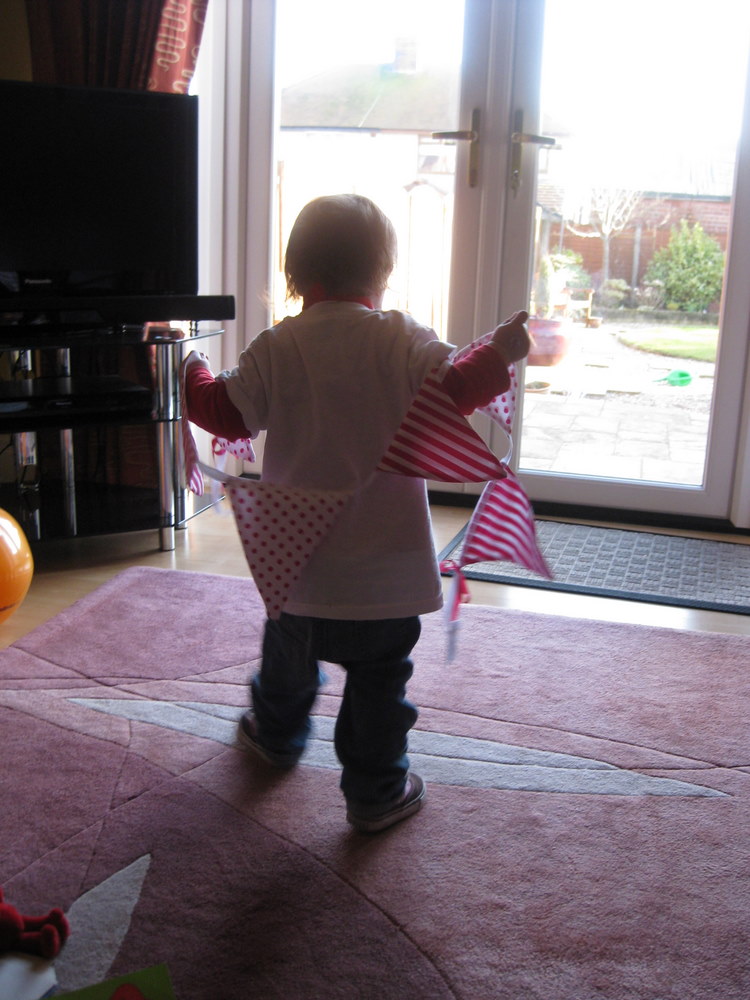 recession by going into the bunting biz. It seems the English are stringing a lot of the stuff these days, while stiffening their upper lips, and it’s kind of admirable. So many empty store-fronts– it’s devastating, really, in a way we barely fathom over here. And maybe it’s just spring time, but things do seem to be beginning to make a turn for the better. The tulips are up, and there are buds on the trees. Here, there is just fresh snow.
We had the most wonderful trip. I bought all kinds of books, but managed to read almost all of them en route, so it’s like I didn’t buy any books at all (very frugal). Stay tuned for an upcoming post about our literary escapades. In fact, stay tuned for upcoming posts galore, but only about our trip, because I can’t think of anything else right now. Real life will come back quickly, I’m sure, but we’re still not finished our washing, I’m still not finished reading my new English books, and there is a bar of Dairy Milk still to be devoured (but not much longer).