May 30, 2011
Today I went to the bookstore
 Today I went to the bookstore and purchased these fine volumes: Margaret Drabble’s A Day in the Life of a Smiling Woman, Carolyn Black’s The Odious Child, and Granta 115. The occasion? Well, after finishing up his contract on Friday, Stuart was offered a new job this afternoon, and starts on Monday. We are thrilled. Further celebrations were had via ice cream cones and sushi take-out. What a lovely, lovely day.
May 30, 2011
Mini Review: The Last September by Elizabeth Bowen
 I’ve almost made it through the Bs, and it’s amazing how much I’ve loved these books. Puts me in the right too for having kept these books around even though I wasn’t bothering to read them– there was a reason after all. The Last September is the third book I’ve read by Elizabeth Bowen– the first was The House in Paris and the second was The Heat of the Day which I found awfully strange and difficult. Unsurprisingly, as it was only her second novel, The Last September is more accessible than the others, more straightforward, but this is also a very mature book for a second novel by a writer who was only thirty when she wrote it.
The Last September takes place in rural Ireland in 1920 during the Irish War of Independence. The setting is wholly domestic, and minor dramas take place between various characters who are so compelling that all of this would be absolutely enough, but for the war taking place in the background. The war is still distant enough that characters don’t take it seriously, or feel that it has anything to do with them. English soldiers stationed nearby are seen as useful for even numbers dances, and the Irish girls fall in love with men, much to their families’ consternation. There are random-seeming bursts of violence, surprising knowledge that familiar neighbours are involved in the cause of independence, but largely, life goes on with its tennis games, afternoon teas, dances, and walks in the woods steeped in import.
It is not that Bowen plays with the juxtaposition, but rather that the background informs the foreground and vice versa. The connections are subtle (as is so much in this novel of manners) and it’s just that the characters don’t notice them, and the reader unversed in Irish history mightn’t either. Which will only make the story’s ending all the more shocking, and cast the entire novel in a whole new light.
May 30, 2011
Wild Libraries I Have Known: Binbrook Library
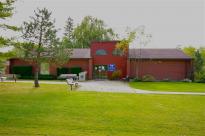 There are only so many wild libraries one person can know, so it is fortunate that some lovely writers are going to continue this series now that I’ve exhausted my own supply of library loves. First up is my dear friend Rebecca Rosenblum, award-winning author of Once, whose second story collection The Big Dream will be published in September.
I have to admit that my original draw to the Binbrook Public Library was the very unliterary plastic slide. I was about 4 I suppose, and this indoor slide, made out of what seemed to be orange Tupperware, was thrilling. Even better, the slide could be inverted to form a very safe version of a teeter-totter. It was hard for a four-year-old to flip this heavy thing, even with the help of her two-year-old brother, but we could do it—a very satisfying feat.
So from a young age, Binbrook Library was always challenging and rewarding me. I’m not from Binbrook—I’m from the next town over, where there’s a very nice, if slightly smaller and less modern library. That one is in a house, and when I finally went there, as an older child, I was concerned that it didn’t look like a library. Binbrook Library will always remain my prototypical library, my library-of-the-mind, and it is a good standard. Opened in 1982 (it replaced an older structure that my parents apparently visited in that pointless time before they had kids), the one-story rambling building had lots of windows, 100% wheelchair accessibility that necessitated an excellent ramp I liked to run up and down. There was also a large, light-filled open area for the afore-mentioned orange slide/rocker, as well as story times, plants, and two large decorative quilts hanging from the wall. The quilts were made by children at the local school.
I did eventually take an interest in the books in the children’s section, though I was especially keen on how many I might be permitted to take home. The librarians and pages all seemed to know who I was, and always greeted me as Becky, though I did not have my own card until I was older. An oblivious child, I did not know who they were until I was much older than that.
Obvious to any former country dweller would be that my parents always drove me to the library—there was no other way for a rural kid to go anywhere. So I guess they were there when I was running up and down that ramp, but I don’t remember their presence except for the final check-out battle over what (how much) I could take. I was sometimes left for library programs and on other occasions just to read. I guess that’s a 1980s thing parents don’t do now, but seriously, the Binbrook library was the safest place in the world.
A favourite library memory, though only loosely tied to the actual library: I was bolting across the gravel parking lot one day, anxious to get inside, and my father waved at an elderly woman walking down the drive from the retirement home behind the library. Then he turned away to do or say something, and when he turned back, she had disappeared. He sent me into the library while he investigated; it turned out she had fallen into a long-grassed ditch, invisible to the drive or the parking lot. She was quite embarrassed when my dad retrieved and righted her, but better than remaining as she was in the grass.
It was a good bit more country back then. Changes since I moved away include subdivisions, and a school friend of mine who is now a librarian walks from the subdivision to work everyday—I haven’t been back in a while, and can’t quite picture that. The other change is that the Wentworth system, which the Binbrook library was part of, has now been folded into the Hamilton one. I wish they’d done that when I lived there; when the two were separate collections, if you wanted a book that wasn’t in the Wentworth system, you had to physically go into Hamilton.
To be honest, I was scared of the big central library in downtown Hamilton—it not only had more than one room, it had half a dozen floors on which to get lost in. Worse, none of the librarians knew my name, which (obviously!) precluded my speaking to them. In grade school, I only went there for extremely demanding school projects; I continued to use the Binbrook library for most of my personal and scholastic reading needs well into my teens. I was quite happy to wander the Dewey-decimal aisles and take my research materials to the long study tables behind the librarian’s desk. As a little kid, I had only wanted to tally up how many, but as I got older I remained convinced that more is better when it comes to books—more resources, more ideas, more points of view. Binbrook’s collection was (and, I assume, is now even more) substantial for a small-town library, but eventually my schoolwork got more specialized and I had to go more often to the city library, or even subject specific ones at McMaster University. I had the Dewey Decimal system almost by heart by that point, and the discovery of the Library of Congress system was one of the many things I held against big strange libraries.
Of course, I eventually learned to use, and even love, a wide variety of libraries. But none of the others ever felt quite like home.
May 29, 2011
Uncustomary Blogs
 “It is now customary for authors to have character blogs…” someone tweeted from the Writers Union of Canada AGM this weekend, which made me think a bit. And then some more after I’d attended the AGM’s “speednetworking” event and spoke to a number of writers with questions about blogs and how to use them. “My publisher told me I should have a blog,” said one of them, but she had no idea what to do with that advice. What I thought about all of this finally is that the most successful author blogs have nothing customary about them.
Madeleine Thien’s blog was noted as the “customary” author blog, but I haven’t seen many other blogs like it. Set up to complement her latest book Dogs at the Perimeter, the blog uses her novel as a platform to launch further and deeper into Cambodian history, to expand upon the research she used for her book, and to round out her characters with a bit of metafictional fun. That her novel so nicely intersects history and story offers great potential for both of these to work together on the blog, to further engage readers who want to know more about the story’s background, to use visual materials that wouldn’t have worked in the novel, and to create a blog that is a work of art onto itself.
Sean Dixon has created blogs for both his novels that work in a similar way. I remember finding The Lacuna Cabal blog once I’d finished reading his novel The Girls Who Saw Everything and being so thrilled that these characters I’d been following could live beyond the page (and it’s not that the page wasn’t enough. It’s that I liked it so much, I wanted more). Unlike with Thien, Dixon is straightforwardly the author of his blog, but his work similarly blurs lines between fact and fiction and the blog is a great place for such blurring to continue. Dixon’s characters are so real to him that he’s happy to tell use more about them, and to provide more background information on how his story grew into an actual book. He’s having similar fun with the blog for his new novel The Many Revenges of Kip Flynn, using photographs of locales depicted in his book, and making connections between his book and the world through links to various things.
What makes these blogs work (and Ami McKay also did a fine job of this with The Birth House, also Amy Lavender Harris with Imagining Toronto), however, is that clearly their authors are enjoying what they’re doing, they’re invested in the project, the blog for its own sake instead of as a marketing tool. The blogs work because the authors find links they want to share with us, the blogs become compendiums of fascinating stuff, and their eclectic-ness is a reflection of the authors’ personalities. That personality is what makes readers keep returning, a blog as unique as the individual who wrote it. The chief attraction of blogs, of course, are the glimpses they offer into the people behind them.
But not all authors need to create blogs of such scale. Perhaps their books don’t lend themselves, or (importantly) the author is a not a big appreciator of blogs and has no idea (or interest) in how they work. It would sort of be like someone who’s never read a book trying to write one– inevitable disaster. Successful bloggers, I think, never have to try that hard– if it doesn’t come naturally, if it doesn’t seem fun, then it’s not worth it.
Blogs are useful for keeping websites current, however, and having a blog but calling it “News” is an easy way to get that practical benefit but not have to pour one’s heart into it. I also like the idea of a blog as a limited project, as with Anne Perdue’s road trip blog, so that the challenge of maintenance is no longer an issue. Establishing at the beginning that a blog will not be updated too often is also a simple way to keep it sustainable.
The nice thing about a blog is that it can be anything, and a writer can adapt the form to suit her needs and interests (and can further adapt as needs and interests change). She can decide how much of her personal life she wants to share, how much focus she wants stuck to a specific book, if she will take the voice of a mentor, an expert, or a friend, if she will focus on herself or her work, or other stuff in the world. She can create a blog that is not only of interest to her readers, but is also useful to her as a writer and a reader. She can–like Madeleine Thien did–choose not to make what is a customary blog, and it’s probably a wise choice. Because who wants to read the blog that is like everybody else’s? (Which, incidentally, is the blog that eventually fizzles out anyway.)
May 26, 2011
This cake is for the party…
 We decided that a six-layer cake needed a bit more height, so we put it on a pedestal and added cake bunting. It was delicious. Only problem was that one slice fed all our party guests, so now we’re looking for some other parties for this cake to be for.
(I stole this idea from here, just in case you’ve mistaken me for someone original. And her cake wasn’t crooked. But then her philosophy also probably isn’t, “Bake a cake, but bake it slant.”)
May 26, 2011
I think you'll be two now and forever
 I’ve written posts before about Harriet being older than she’s ever been, like back when she was seven weeks old, and I was amazed at how far we’ve come. Or when she was three months old, and when she turned one, or six months ago when she was a year and a half–these signposts that have us take stock and realize that we’ve been moving forward all along, even when we spend mornings reading stories on the couch and it doesn’t much feel like it.
But this is different. My friends, never before has Harriet been two-years-old, one hundred and four weeks, an upstanding (most of the time), fast-running, fierce shrieking, word-speaking, unabashed hugger and devourer of tiny muffins, counter of cars, page-turning, tutu-wearing feral creature who reads the newspaper while she eats her lunch, looking for advertisements with pictures of cars. Cars with wheels.
The age of two is a bit like colic. It’s a dreaded thing that everybody warns you about, and some people say it doesn’t exist, but others spent nine months suicidal because of it. I thought that since Harriet has been annoying since birth, we might miss out on the terrible. Her tantrums started when she was about a year old, so I was well-versed in the child lying face-down, kicking and pounding the floor and crying until she pukes. I thought I knew what people were talking about when they were talking about two years old, but like everything to do with each new stage of parenthood, I had no idea.
Two is terrible in a brand new way. It’s the kid who is trekked all the way to swimming lessons then refuses to get into the pool, the kid who won’t say hello to her grandmother on the phone, who won’t eat unless she’s sitting on her mother’s lap, who wants her father to get out of the way and so stands with her hands on her hips and says, “Bye, Daddy. Bye, Daddy.” It’s the kid who knows she can climb up on a kitchen chair to turn the stereo on, but also knows she isn’t supposed to, and is in thrall to the tension between these ideas. She’s fascinated by her ability to provoke a reaction, and by her dawning awareness of being a free agent in the world. She also has the self-preservation instinct of a lemming.
But two is also happiness beyond the wildest dreams. It’s the kid who’s fascinated by prepositions, and lying in bed between her parents on Saturday morning looked at both of us and said, “Harriet in family.” It’s the kid who wants to go outside always, and never wants to come in. Who loves to talk about her friends, and never sees any of them (or does anything) without having to be pulled away shouting, “More!” She loves chocolate, ice cream, and this weekend decided that cupcakes were called “Happy Birthday Muffins”. She has just learned the word, “Nobody” and loves to play her guitar, and makes up songs in a combination of English and Harriet-ese. She loves car-rides, puppies, dancing, teapots, puddles, stickers, clocks, digging in dirt, watering cans, and dustpans. Her favourite author is Byron Barton, among others. If it’s close enough to bedtime, she will laugh hysterically about anything. She loves to help with everything we do, and sometimes she even manages to.
Harriet is two, which is the oldest she has ever been, but also not much older than seven weeks old, relatively speaking, (and still “nearly new” according to A.A. Milne). And it’s true what they say, though it wasn’t for a long time–I can’t imagine my life without her. I don’t know how I got along before, but now I’m so glad I don’t have to. She is everything I ever wanted her to be, and me because of her.
We love her, we love her, we do.
May 24, 2011
Pickle Me This's Motherhood Library
 Pregnancy Books:
– Bear With Me: What They Don’t Tell You About Pregnancy and New Motherhood by Diane Flacks
–How to Get a Girl Pregnant by Karleen Pendleton Jimenez
Birthing Books*:
– Great Expectations: Twenty-Four Stories about Childbirth by Dede Crane and Lisa Moore (eds)
– Birthing from Within by Pam England
– Ina May’s Guide to Childbirth by Ina May Gaskin
(Cannot vouch for the second and third book, as I had a scheduled c-section. But was definitely all right with the c-section on account of having read the first book, and I will never forget Stephanie Nolen on Ina May Gaskin, ever. So funny and made me feel better in retrospect)
Books About New Motherhood:
– A Life’s Work: On Becoming a Mother by Rachel Cusk
– Making Babies by Anne Enright
– Operating Instructions by Anne Lamott
Books About Babies/Motherhood/Parenthood
–The House With the Broken Two: A Birth Mother Remembers by Myrl Coulter
–Nobody’s Mother: Life Without Kids by Lynn van Luven
– Double Lives: Writing and Motherhood by Shannon Cowan, Fiona Tinwei Lam, and Cathy Stonehouse (eds.)
– Motherhood and Blogging: The Radical Act of the Mommy Blog by May Friedman and Shana L. Calixte (eds.)
– Reading Magic by Mem Fox
– The Philosophical Baby by Alison Gopnik
– The Big Rumpus by Ayun Halliday
– Between Interruptions: 30 Women Tell the Truth About Motherhood by Cori Howard (ed.)
– Dream Babies: Childcare Advice from John Locke to Gina Ford by Christina Hrdyment
– Mother Knows Best: Talking Back to the Experts by Jessica Nathanson and Laura Camille Tuley (eds.)
– Pathologies by Susan Olding
– The Divided Heart: Art and Motherhood by Rachel Power
– What Mothers Do by Naomi Stadlen (this book is deeply troubling, by a writer with no understanding of maternal ambivalence. Which is too bad because I think ambivalent mothers would benefit most from the book, which explains how those tedious, dreary early days are so important, and so absolutely full of doing, but we just fail to recognize it and credit mothers for it).
–365 Activities You and Your Baby Will Love
Fiction:
– A Big Storm Knocked it Over by Laurie Colwin
– Goodnight Nobody by Jennifer Weiner
– Novel About My Wife by Emily Perkins
–A Large Harmonium by Sue Sorensen
Poetry:
–Joy is So Exhausting by Susan Holbrook
–Hump by Ariel Gordon
–Sweet Devilry by Yi-Mei Tsiang
 Books About Sleep (aka The Trajectory of a Downward Spiral)*
–The Baby Whisperer
–The No-Cry Sleep Solution
–Dr Sears’ Nighttime Parenting Book
*Note that none of these books did me any good, except the Dr. Sears’ book and only because it gave me permission to keep not doing anything. One day my daughter just learned how to sleep, without a book, even.
***
“If she feels disoriented, this is not a problem requiring bookshelves of literature to put right. No, it is exactly the right state of mind for the teach-yourself process that lies ahead of her. Every time a woman has a baby she has something to learn, partly from her culture but also from her baby. If she really considered herself an expert, or if her ideas were set, she would find it very hard to adapt to her individual baby. Even after her first baby, she cannot sit back as an expert on all babies. Each child will be a little different and teach her something new. She needs to feel uncertain in order to be flexible. So, although it can feel so alarming, the ‘all-at-sea’ feeling is appropriate. Uncertainty is a good starting point for a mother. Through uncertainty, she can begin to learn.” –from What Mothers Do by Naomi Stadlen (who I quote because in this, she got at least one thing right)

May 22, 2011
Mini Reviews: English Journey and Nightwood
This reading alphabetically thing is working for me, forcing open books that have been languishing on the shelf for far too long. The only problem is that I got three new books on the weekend (plucked out of a box on the sidewalk), which does make me fear that the alphabet will never be got through. The other problem is whatever weirdness will ensue by me following Djuna Barnes with Erma Bombeck, two writers with nothing in common except the letter B. In fact, I think that Djuna Barnes might be the opposite of Erma Bombeck. We shall see…
 Anyway, I read Beryl Bainbridge’s An English Journey: Or The Road to Milton Keynes last week, which I acquired for $1 at the UofT Bookstore sidewalk sale back when my life was as such that I’d push a stroller for miles in miles in aimless pursuit of a nap. I’d never read Beryl Bainbridge, but I like England, and I’d just read this review of JB Priestly’s English Journey, a book commemorated by Bainbridge 50 years later in the television program recreating Priestly’s travels out of which her book was born. And I loved it, first because Bainbridge is a fabulous prose writer, with a marvelous dry wit. And because the contrast between her “modern” England of 1983 and today has made this book an historical document onto itself. Because of lines like a girl “with thighs shaped like cellos”, “It seemed there was neither time nor room for pedestrians. We were literally a dying breed”. How she describes her family: “Class conscious, [everyone was] either dead common or a cut above themselves. And “I’ve never worn a hat since my mother bought me on at the Bon Marche and I carried home potatoes in in when my carrier bag bust.” That this is a writer who can write, “I was in Coronation Street more than twenty-five years ago. I played one of Ken Barlow’s girlfriend’s before he married Valerie.” Which I appreciate, and I don’t even know Valerie.
***
I don’t know that there is a book that has sat longer on my shelf than Djuna Barnes’ Nightwood, which a friend of mine gave to me in  1997. According to a note on the inside cover, I’d read it in 2001, but I couldn’t remember having done so, and no wonder, really. With apologies to T.S. Eliot, I think I‘m just an ordinary reader. I’m not going to say that this is a bad book, but only that I was almost wholly unable to penetrate its goodness. Almost wholly, because there were certain parts of the book where I felt things had really got going, but then Dr. Matthew O’Connor would open his mouth and start talking again. (In his intro, T.S. thought the Doctor was the best part. This is one of the reasons I suspect T.S. and I are not meant to be kindred souls.)
Apparently, Barnes is quite Joycean, which might be part of the problem. Eliot wrote that the novel would “appeal primarily to readers of poetry”, and I get that, in particular because of how much Nightwood reminded me of “The Wasteland”. But even “The Wasteland” rendered as 170 pages of prose would be too much. In Nightwood, if I just let the words fall the way I do whilst reading a poem like “The Wasteland”, I would find myself having drifted entirely away. So then I read more carefully, get to the bottom of every line, which is also unsatisfying because the prose makes no sense at all except in a very general sense, sounds pretty, washes over, but then, oops! There I’ve gone away again. You see? For me, there was no joy in the exercise. And I don’t think it’s every a very good thing when one of the best bits of a novel is its brevity.
May 22, 2011
A prose that is altogether alive
“But I do mean that most contemporary novels are not really “written”. They obtain what reality they have largely from an accurate rendering of the noises that human beings currently make in their daily simple needs of communication; and what part of a novel is not composed of these noises consists of prose which is no more alive than that of a competant newspaper writer or government official. A prose that is altogether alive demands something of the reader that the ordinary novel-reader is not prepared to give.” –T.S. Eliot, in an introduction to Djuna Barnes’ Nightwood, which I love for the honesty of a paragraph beginning, “When I first read the book I found the opening movement rather slow and dragging…”






